
Unsolved Files Archive
A man bought a ticket with cash, handed a flight attendant a note about a bomb, took two hundred thousand dollars and four parachutes, and walked off the back of a Boeing 727 into the rain. The FBI worked the file for forty five years and stopped in 2016 without a name.
Summary
On the afternoon of November 24, 1971, a man paid cash at a Northwest Orient counter in Portland, Oregon, and gave the name Dan Cooper.
The ticket exists. The FBI photographed it and put the photograph in its own public archive, and the name printed on it is the only name in this case that anyone can be certain about.
That name was Dan Cooper. The name on every book written since is not, and the Bureau answers the question on its own page without ceremony: “It was apparently a myth created by the press. We did question a man with the initials ‘D.B.’ but he wasn’t the hijacker.”
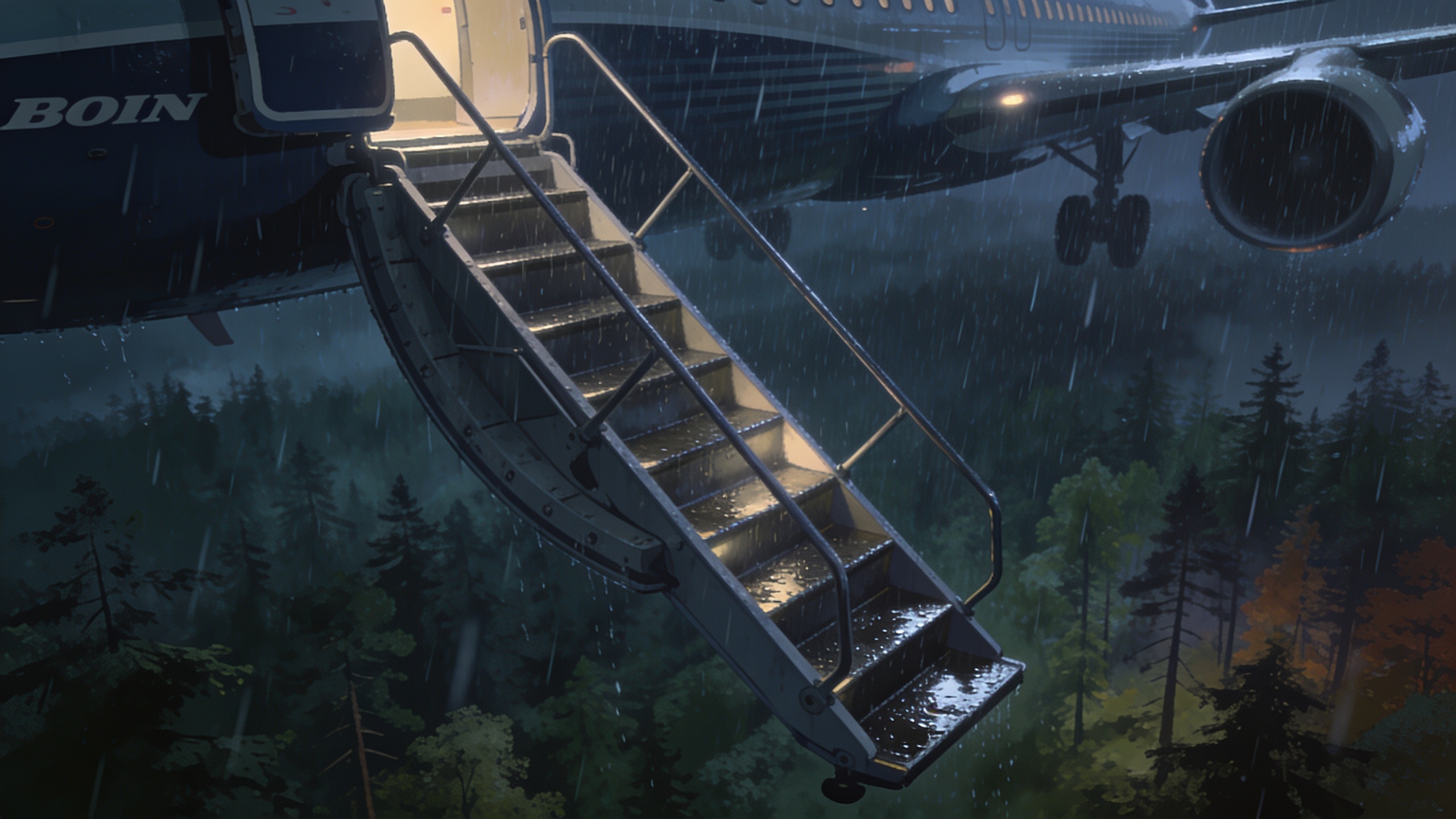
Somewhere over southwestern Washington that night, in rain and darkness, he lowered the aft airstairs of a Boeing 727 and stepped out of the aircraft.
The aircraft landed at Reno with the stairs still down. The cabin behind the cockpit was empty.
Nobody saw him go. Nobody photographed it. No trace of the man has ever been recovered.
The Bureau filed the investigation under the name NORJAK and kept it open for forty five years.
- Case Status: Unresolved. Active FBI investigation ended July 8, 2016
- Classification: Aircraft hijacking and extortion, FBI case name NORJAK
- Date: November 24, 1971, jump reported at around eight in the evening
- Location: Northwest Orient Flight 305, Portland to Seattle, exit over southwestern Washington
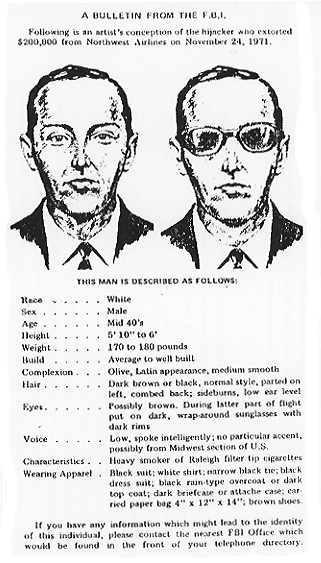
- Subject: A passenger ticketed as Dan Cooper, described by two flight attendants, never identified
- Strongest Evidence: Bundles of the ransom money uncovered on a Columbia River sand bar on February 10, 1980, serial numbers matched against bank microfilm taken before the money was handed over
- Weakest Point: No body, no parachute, no briefcase, no confirmed suspect, and a jump point that independent analysts still argue about
Everything after that ticket splits into two piles.
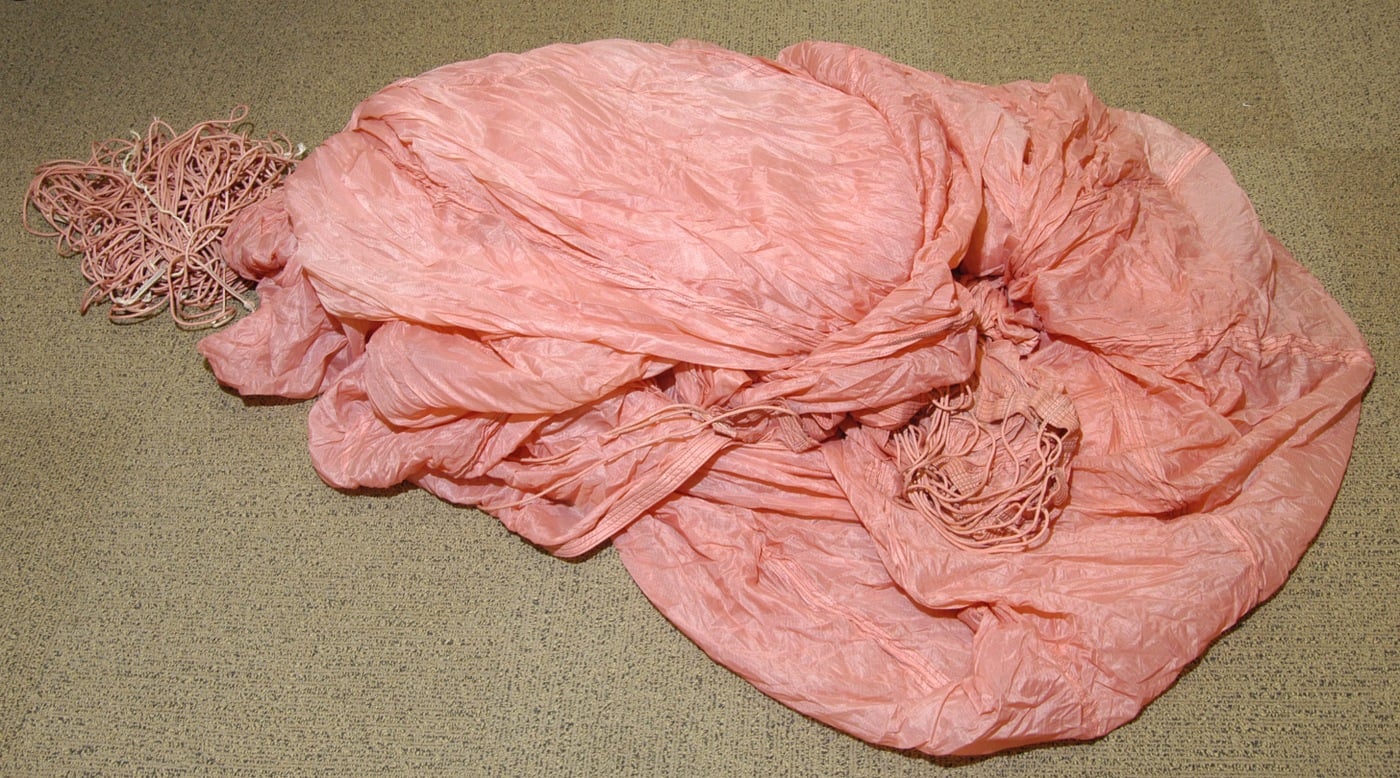
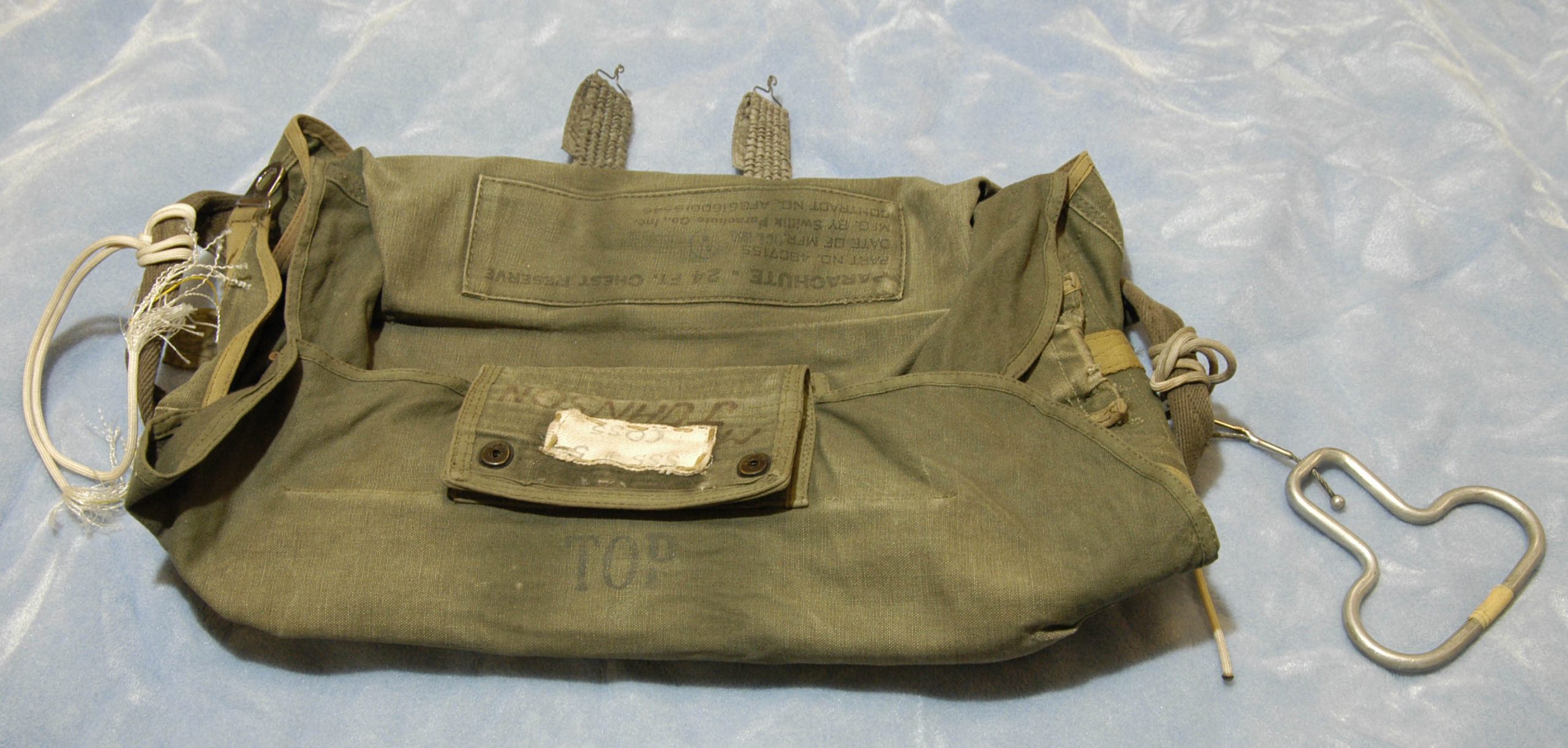
One pile is physical and small. A necktie left on a seat. Two parachutes left in the cabin. A bag and a length of cord. A weathered stack of banknotes in river sand.
The other pile is paper, and it is enormous. The Bureau’s public vault runs to one hundred and twenty one parts, and it was still growing in 2025.
Forty five years of investigation, and fifty five since the jump, produced a case documented in extraordinary depth and answered at no point.
Background
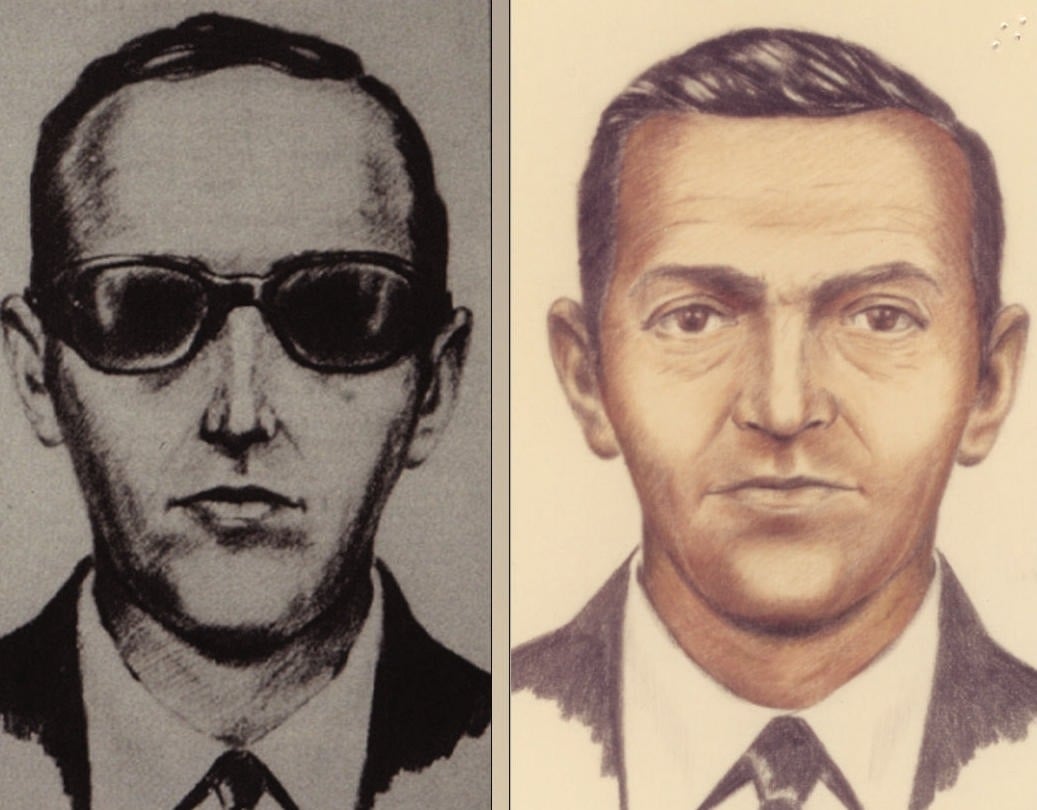
The description that survives comes from the crew, and it is the flattest description imaginable. A dark suit. A tie. A briefcase. A man who ordered a bourbon.
He gave a folded note to flight attendant Florence Schaffner after takeoff. The content of that note is recorded in the FBI files: he had a bomb.
He then opened the case beside him. What the witness accounts describe inside is red cylinders and wire.
The device was never recovered and was never confirmed to have been real. That distinction has never mattered to anyone on that aircraft, and it does not matter now.
What he asked for went to the ground through the crew, and it was specific.
Two hundred thousand dollars in twenty dollar bills, in the FBI’s own wording. Four parachutes, which the Washington state history archive breaks down as two back rigs and two front reserves of the type that clips to a main. A refuelling truck standing on the tarmac when the aircraft arrived. Meals for the flight crew.
That last item is the one people skip. A man holding an airliner with a briefcase stopped to order dinner for the pilots.
The four parachutes suggested a man who intended to take somebody out of the aircraft with him, or a man who wanted the people on the ground to believe he might. He was given four, and one of the two he ended up taking had been sewn shut for classroom demonstration and could not open.
The money was photographed before it left the bank. Seattle First National Bank held notes with non sequential serial numbers and had those numbers recorded on microfilm as a routine measure against robbery, according to that same archive. That routine is the reason this case has any physical anchor at all.
The Exchange at Seattle
The FBI puts what happened on the ground in one line: “the hijacker exchanged the flight’s 36 passengers for the money and parachutes.”
Thirty six people walked off into the terminal. The crew stayed.
The aviation history site This Day in Aviation names them: Captain William A. Scott, first officer William Rataczak, flight engineer Harold E. Anderson, and flight attendants Alice Hancock, Florence Schaffner and Tina Mucklow. That list is not a federal document, and it is carried here as what it is.
Mucklow stayed closest to him, for roughly five hours, and became the FBI’s principal witness to the entire event.
The Second Leg
The Bureau says he ordered a course for Mexico City. The conditions he attached to that course are recorded in the same state archive account: landing gear down, flaps at fifteen degrees, no higher than ten thousand feet, an altitude at which the cabin would not be pressurized, and the aft stairs down.
Those are not the instructions of a man improvising. They are the settings that make a Boeing 727 slow enough and low enough for a man to walk out of it.
He took two of the four parachutes, including the sewn demonstration rig. He used cord cut from one of the ones he left behind to tie the money to his body.
Somewhere over the timber of southwestern Washington the aft stairs came down.
At about 8:13 that evening the tail of the aircraft pitched upward. That time comes from the crew through later published accounts rather than from the Bureau, which says only that it happened a little after eight.
Nobody in the cockpit saw anything. There was nothing to see.
The 727 flew on and landed at Reno with the stairs still down, throwing sparks along the runway.
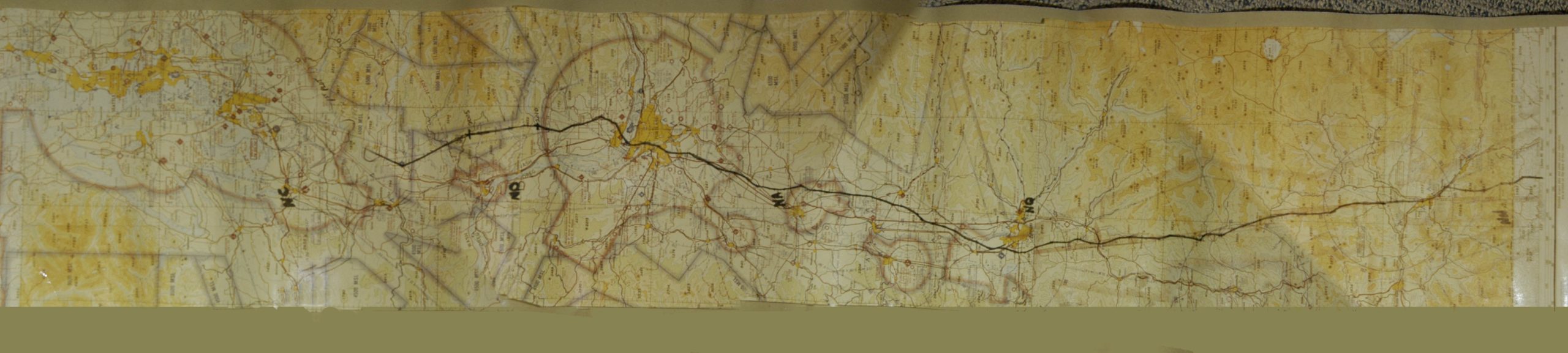
The search that followed put agents, deputies and helicopters over the forest around Ariel, Washington, and ran into December.
It started again after the thaw. In March and April 1972, on HistoryLink and on the public compilations that footnote the search records rather than on any federal page, teams of agents worked Clark and Cowlitz counties with some two hundred soldiers from Fort Lewis, eighteen days in March and eighteen more in April.
They found nothing. No canopy in a tree. No harness. No case. No man.
Timeline of Events
- November 24, 1971, afternoon: A ticket is bought with cash at Portland under the name Dan Cooper.
- Shortly after takeoff: A folded note goes to flight attendant Florence Schaffner. He has a bomb.
- In the air: The demand is set at two hundred thousand dollars in twenty dollar bills, four parachutes, a refuelling truck on the tarmac and meals for the crew.
- Before delivery: Seattle First National Bank supplies notes with non sequential serial numbers, already recorded on microfilm as a routine measure against robbery.
- On the ground at Seattle: The 36 passengers are exchanged for the money and the parachutes. The crew stays aboard. Tina Mucklow remains closest to him, for about five hours.
- That evening: The aircraft takes off again on a course for Mexico City, gear down, flaps at fifteen degrees, below ten thousand feet, cabin unpressurized, aft stairs down.
- About 8:13 p.m.: The tail pitches upward over southwestern Washington. He is gone with two of the four parachutes and the money tied to his body. The FBI’s own account says only a little after eight.
- Later that night: The 727 lands at Reno with the aft stairs still down, throwing sparks on the runway. The cabin is empty.
- November and December 1971: Agents, deputies and helicopters search the forest around Ariel, Washington. Nothing is recovered.
- February 16, 1972: Special Agent Charles E. Farrell completes a 336 page report on the investigation, released to the public only in 2025.
- March and April 1972: After the thaw, agents work Clark and Cowlitz counties with about two hundred soldiers from Fort Lewis, eighteen days in March and eighteen in April. Nothing is recovered.
- November 1978: A deer hunter finds a placard from the aft stairs of a Boeing 727 about thirteen miles from Castle Rock, Washington. Published accounts disagree on which side of the town.
- February 10, 1980: Brian Ingram, eight years old, uncovers a rotting package of twenty dollar bills in the sand at Tina Bar on the Columbia River. The FBI records the amount as $5,800.
- May 21, 1986: A proposed judgment on dividing the recovered money is submitted to Judge Helen Frye.
- 2009: The FBI grants a private research team full microscopic access to the necktie left in the cabin.
- August 2011: The FBI reports no DNA match for a suspect put forward publicly by his niece.
- July 8, 2016: The FBI redirects the resources allocated to the case. The active investigation ends.
- July 2025: A 398 page case file is released, containing hundreds of tips and suspect profiles.
- October 2025: Part 110 of the FBI vault adds 668 pages, including the 1972 Farrell report.
- December 2025: After two years of forensic testing, the FBI returns a parachute belonging to the family of a former suspect, with no conclusion attached to it.
Key Evidence
This is a case with almost no evidence and almost unlimited documentation. Everything he touched that was recovered fits on a single table.
Five bodies of evidence carry the case:
- The necktie he left on his seat, which carries a partial DNA sample and a particle profile examined in 2009 and again in the years since.
- The ransom money recovered at Tina Bar in 1980, $5,800 in twenty dollar bills, the only part of the two hundred thousand ever found.
- The two parachutes left in the cabin, and the bag and cord he used on the two he took.
- The placard from the aft stairs of a 727, found by a hunter in November 1978 in the general corridor of the flight.
- The paper record: one hundred and twenty one parts in the FBI vault, and a United States Attorney’s case file at the National Archives in Seattle that is still largely undigitized.
The Tie He Left on the Seat
He took the money, the case and two parachutes. He left his necktie on the seat.
It carries a partial DNA sample, and that is the reason the file never fully died.
In 2009 the FBI allowed an outside team led by Tom Kaye to put the tie under a microscope in full. They found particles on it, including titanium and rare metals, and the finding itself is not in dispute.
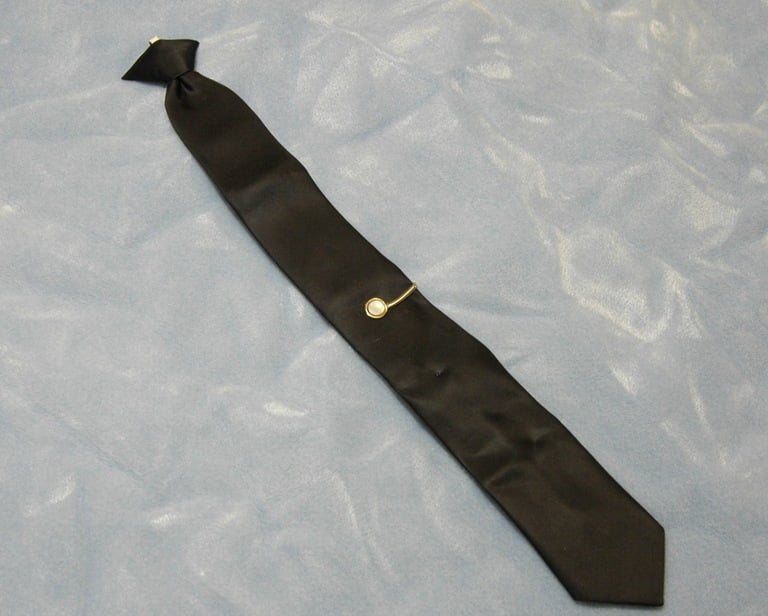
What the particles mean is another matter entirely.
The reading that travelled furthest is that titanium in that quantity, in 1971, points to a man who worked around aerospace metal.
The counterweight comes from within the research community itself. The long running case site dbcooperhijack.com puts it in a single line: “gold was found in the same percentage as titanium, yet no one is saying D.B. Cooper worked in a gold mine.”
The work continues. A paper by Kaye and Rhodes on automated particle analysis of the tie appeared in the Journal of Forensic Sciences, volume 71, issue 5, published online on May 28, 2026.
It is a new method applied to the same fifty five year old object. It identifies nobody.
The Money on the Beach
On February 10, 1980, an eight year old boy named Brian Ingram was digging in the sand of a bar on the Columbia River, at a place called Tina Bar.
He uncovered a rotting package of twenty dollar bills.
The FBI account gives the amount in three words and is exact on the rest: “a rotting package full of twenty-dollar bills ($5,800 in all) that matched the ransom money serial numbers.”
Five thousand eight hundred dollars out of two hundred thousand. Roughly one bill in thirty five, nine years late, in river sand.
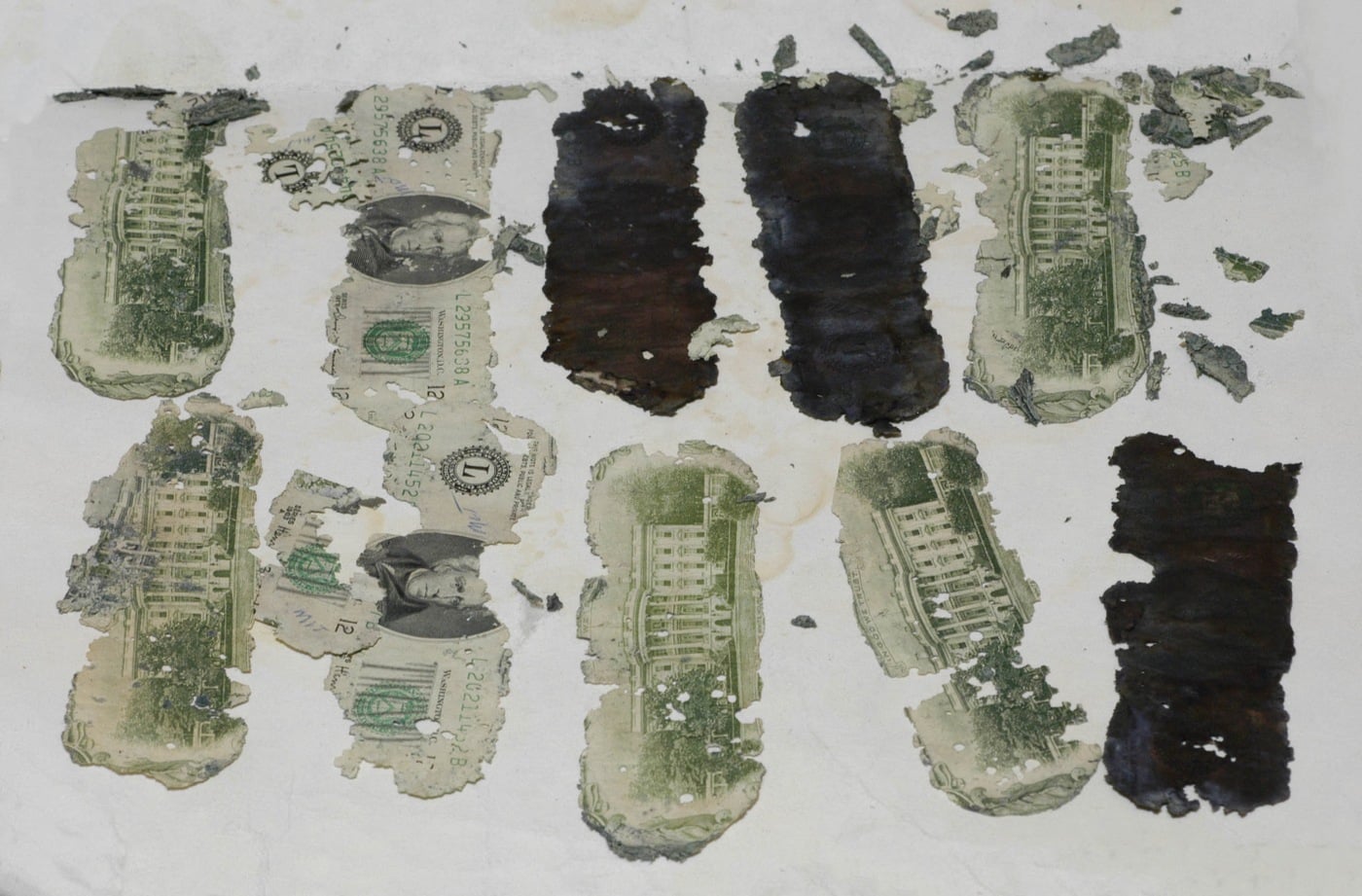
That is the hardest fact in the entire case, and it explains nothing.
It puts a fraction of the ransom in river sand, nine years after the jump, at a location that sits awkwardly against every reconstruction of where the man went out of the aircraft.
The money then produced its own legal afterlife. A proposed judgment on dividing the recovered notes went to Judge Helen Frye on May 21, 1986.
Nothing else from that microfilmed list has ever been reported found. Not in a bank, not in a wallet, not in a wall.
What He Left in the Cabin
He asked for four parachutes and jumped with two, one of them the sewn demonstration rig.
Skeptics read that as an amateur who did not check what he was given. Believers read it as a man in a hurry who had one working canopy and did not care about the second.
The FBI holds the two he left, along with the bag and the length of cord he cut to tie the money to his body.
Then there is the placard.
In November 1978 a deer hunter found a metal plate carrying the instructions for lowering the aft stairs of a Boeing 727, about thirteen miles from Castle Rock, Washington.
The two published accounts of that find agree on the month and on the distance and disagree on the direction. One puts it east of the town, the other west. Thirteen miles in the wrong direction is twenty six miles of difference in a case that is argued over single ridgelines.
If those accounts are right, something came off an aircraft of that type in that general corridor. It fixes no point, no date and no man.
The Line on the Map
The aircraft was tracked by air traffic control, so the corridor is not seriously in question. The exact point where he went out of it is.
So is the height. Ten thousand feet is the number attached to this case everywhere, usually written as the altitude he jumped from. It is not that. It is the ceiling he ordered the aircraft to stay under, and no federal page read for this file states a jump altitude at all.
Independent reconstructions have worked the problem for years, using the radar corridor and the weather data of that night. The most careful of them are open about what they depend on, which is an assumed wind speed and an assumed moment of exit.
Move either assumption and the landing zone moves with it, across miles of timber.
This sits under the ground search that failed. Hundreds of people searched a circle drawn around numbers that nobody could verify.
Official Explanation
The Bureau never named a hijacker, and it never claimed to have one.
It also never said the sentence that follows this case everywhere. Not one federal page read for this file calls it the only unsolved hijacking in American history. The Bureau’s own wording is smaller and more careful: one of the great unsolved mysteries in FBI history. The larger sentence belongs to newspapers.
What it does have is a position on the jump, and the wording of it is careful. In its own account of the case, the FBI writes: “Perhaps Cooper didn’t survive his jump from the plane. After all, the parachute he used couldn’t be steered, his clothing and footwear were unsuitable for a rough landing, and he had jumped into a wooded area at night—a dangerous proposition for a seasoned pro, which evidence suggests Cooper was not.”
Read it again. The sentence begins with “perhaps” and ends with an assessment of skill, not a finding of death.
The man who carried the case longest went further in private, and it is worth setting his temperature into the record.
Ralph Himmelsbach ran the investigation from 1971 until his retirement in 1980 and later wrote a book about it. A San Francisco newspaper quoted him in 1996, in a passage carried since by the Seattle Times: “He’s a sleazy, rotten scumbag, and I hope he died a miserable, wretched death.”
That is the opinion of the lead investigator. It is not evidence, and he never claimed it was.
The FBI has never identified the hijacker and has never charged anyone with the hijacking of Flight 305.
Its stated view is that the man perhaps did not survive the jump, and perhaps is the Bureau’s own word. It has never produced a body, a parachute or a piece of his equipment to support that view.
On July 8, 2016, according to the Seattle Field Office, the Bureau “redirected resources allocated to the D.B. Cooper case in order to focus on other investigative priorities.”
That last sentence is not a closure. It is a budget decision written in the flattest language the government owns, and it is the nearest thing to an ending this case has.
The paper did not stop when the investigation did.
In July 2025 the Bureau released a 398 page file of tips and suspect profiles, among them a man agents had noted was confined to a wheelchair. In October 2025, Part 110 of the vault added 668 pages, including a 336 page report written by Special Agent Charles E. Farrell and dated February 16, 1972.
That report was fifty three years old before the public saw it. It named nobody either.
Alternative Theories
He Died That Night
This is the Bureau’s own reading and the one that requires the fewest inventions.
A man in a business suit, with an unsteerable canopy and footwear the Bureau itself calls unsuitable, went into forest at night in the rain. Nothing about that arrangement favours the jumper.
The case against it is a hole where a body should be. No remains, no harness, no canopy, no briefcase, and no scrap of the equipment has been found in fifty five years of looking, in country that has been logged, roaded and walked over repeatedly since.
Researchers who reject the death theory make exactly that point, and the point is not weak.
Richard Floyd McCoy Jr.
The most uncomfortable candidate, because he demonstrably did the same thing.
McCoy hijacked an aircraft, took a ransom and jumped from the aft stairs of a Boeing 727. He had military and parachuting experience.
The FBI excluded him on the descriptions, saying he did not match what the two flight attendants reported. His family has maintained an alibi for the 1971 holiday. Bureau documents released in 2020 show that a family DNA sample had still not been obtained years after his death.
The theory came back in 2024 when a parachute connected to the McCoy family was passed to the FBI. After two years of testing, the Bureau returned it in December 2025. According to the family, an agent said the parachute “was neither being credited or discredited, but rather that they got all the data off it that they could, and they were returning it.”
That is the most quoted piece of new evidence in this case, and it settled nothing.
Sheridan Peterson
Peterson was a technical editor and writer at Boeing, which is to say a man who worked with the documentation of the aircraft in question, and an experienced smokejumper.
The investigator Eric Ulis has said publicly that he is ninety eight percent certain Peterson was the hijacker.
Against it: Peterson said he was in Nepal at the time, the FBI never arrested or charged him, and the evidence offered is acknowledged by its own proponent as circumstantial. He died in January 2021, aged ninety four, without saying anything else.
Kenneth Peter Christiansen
A former paratrooper, a smoker, a bourbon drinker, put forward by a private investigator and a book.
Florence Schaffner, who took the note, reportedly said his photograph looked more like the man than the others she was shown, and stopped short of identifying him.
The Bureau’s answer has been consistent. There is no direct evidence. There is no confession, no document, no physical link.
The Confessions
Three men have been placed in this case by someone who loved them or knew them.
Duane Weber is reported to have told his wife on his deathbed in 1995 that he was Dan Cooper. The account has circulated since 2000 and rests entirely on her.
Lynn Doyle Cooper was named by his niece in 2011. In August of that year the FBI reported no match with, in its own careful wording, “the partial sample of DNA that they have in their files.”
Walter Reca was named in 2018 by a friend who said he had confessed personally. Reporters checking the publisher’s account found the jump location in the story sitting roughly one hundred and fifty miles from the zone the FBI worked, and the Seattle office declined to comment.
Deathbed confessions are the cheapest currency in unsolved cases. They cost the speaker nothing and they cannot be cross examined.
Robert W. Rackstraw
The most heavily promoted solution of the last decade. A private cold case team led by Thomas Colbert investigated Rackstraw for five years and published a book in 2016 arguing that the case was solved.
The FBI began looking at Rackstraw in 1979 and eventually excluded him. Researchers on the opposite side of the argument have called the theory propaganda at its worst, on the ground that he does not match the physical descriptions the witnesses gave.
Rackstraw died in 2019. He never confessed to anything.
- He died in the jump: Supported by the conditions, the equipment and the Bureau’s own reading. Undercut by the total absence of remains or gear.
- Richard McCoy Jr.: Strongest match on method, excluded on witness description, revived by a parachute the FBI returned without a conclusion.
- Sheridan Peterson: Right skills and right employer, wrong continent according to his own account, and no physical evidence at all.
- Kenneth Christiansen: Fits the habits and the background, fails on the absence of any direct link.
- The confessions: Weber, Lynn Doyle Cooper and Reca all rest on a single witness each, and one of them was ruled out by DNA.
- Robert Rackstraw: The most publicised solution, investigated and set aside by the FBI, disputed by other researchers on the descriptions.
Unresolved Questions
Some of these have been asked since 1971. Others come out of the documents and are asked here.
- How did part of the ransom reach a sand bar on the Columbia River, nine years later, when no other physical trace of the man ever surfaced anywhere?
- Why has not one further note from the microfilmed list ever been reported found, in half a century, on a list every bank in the country could check?
- If he died on landing, where are the two parachutes, the harness and the briefcase, in country that has been logged and roaded ever since?
- On whose numbers was the 1971 search zone drawn, when independent analysts still cannot agree on the exit point using the same radar corridor?
- If ten thousand feet was the ceiling he ordered rather than a measured altitude, how high was the aircraft when the tail pitched upward at 8:13?
- Why do the two published accounts of the 1978 placard put it on opposite sides of Castle Rock, and where is the federal record of that find?
- What was in the 336 page report of February 16, 1972 that required fifty three years before the public could read it?
- Why does the United States Attorney’s case file at the National Archives remain largely undigitized while the Bureau publishes vault part after vault part?
- If gold appears on the necktie in the same proportion as titanium, what is the particle profile actually recording about where that tie had been?
- What did two years of FBI forensic testing on a parachute produce, if the result was neither credited nor discredited when the item was handed back?
- Why did the man ask for four parachutes and then jump with one that had been sewn shut, and what does that say about how much he knew?
None of these questions has an answer waiting behind it. Together they describe the shape of the hole, which is not a motive and not a suspect. It is the stretch of minutes between the stairs coming down and a cabin with nobody in it.
Where It Stands
This case is usually told as a puzzle about identity. That framing is the reason fifty five years of work reads like failure.
Identity is the one thing this file has never produced. The man handed over no document and gave a name that has never been attached to a living person. What the record can be measured against is narrower: what was proven, and what grew around it.
- CONFIRMED, 95 to 100 percent: The hijacking of Flight 305 on November 24, 1971. The ticket bought under the name Dan Cooper, and the name D.B. Cooper as a press error the FBI itself calls a myth. The exchange of 36 passengers at Seattle for two hundred thousand dollars in twenty dollar bills and four parachutes. The second takeoff on a course for Mexico City. The exit through the aft airstairs, and the landing at Reno with those stairs still down. The recovery of $5,800 at Tina Bar on February 10, 1980, matched to the bank’s serial numbers. The end of the active investigation on July 8, 2016.
- PROBABLE, 60 to 90 percent: That he did not survive the jump, on the FBI’s own reasoning, around 70. That he left the aircraft at about 8:13 p.m., on the crew’s account carried by later writers rather than by the Bureau, around 60. That the 1978 placard came off an aircraft of this type in this corridor, around 70, with its location disputed. That the general flight corridor is correctly reconstructed, around 65. That the March and April 1972 search ran at the scale reported, around 65. That the particle profile on the necktie is real, on the report of the team the Bureau admitted to the evidence.
- POSSIBLE, 20 to 50 percent: Richard McCoy Jr., around 30. Kenneth Christiansen, around 25. Duane Weber, around 20. The claim that the returned parachute connects McCoy to this case, around 20.
- DISPUTED or DEBUNKED: Robert Rackstraw, investigated and set aside by the FBI. Walter Reca, contradicted on location by reporters who checked. Lynn Doyle Cooper, excluded by DNA in 2011. Any claim that the parachute returned in December 2025 identified the hijacker. Ten thousand feet quoted as the measured jump altitude. And the line that this is the only unsolved hijacking in American history, which no federal source read for this file says.
The confirmed column is short and it is federal. It comes from an evidence photograph of a ticket, a bank microfilm, a sand bar, and a press release.
The probable column is where the case actually lives, and every entry in it is an inference rather than a finding. The FBI’s own sentence on the jump begins with “perhaps.” The exit point is a calculation with two unverifiable inputs. The most quoted altitude in the case is a ceiling he ordered, not a height anyone measured. The tie holds titanium, and it holds gold in the same proportion.
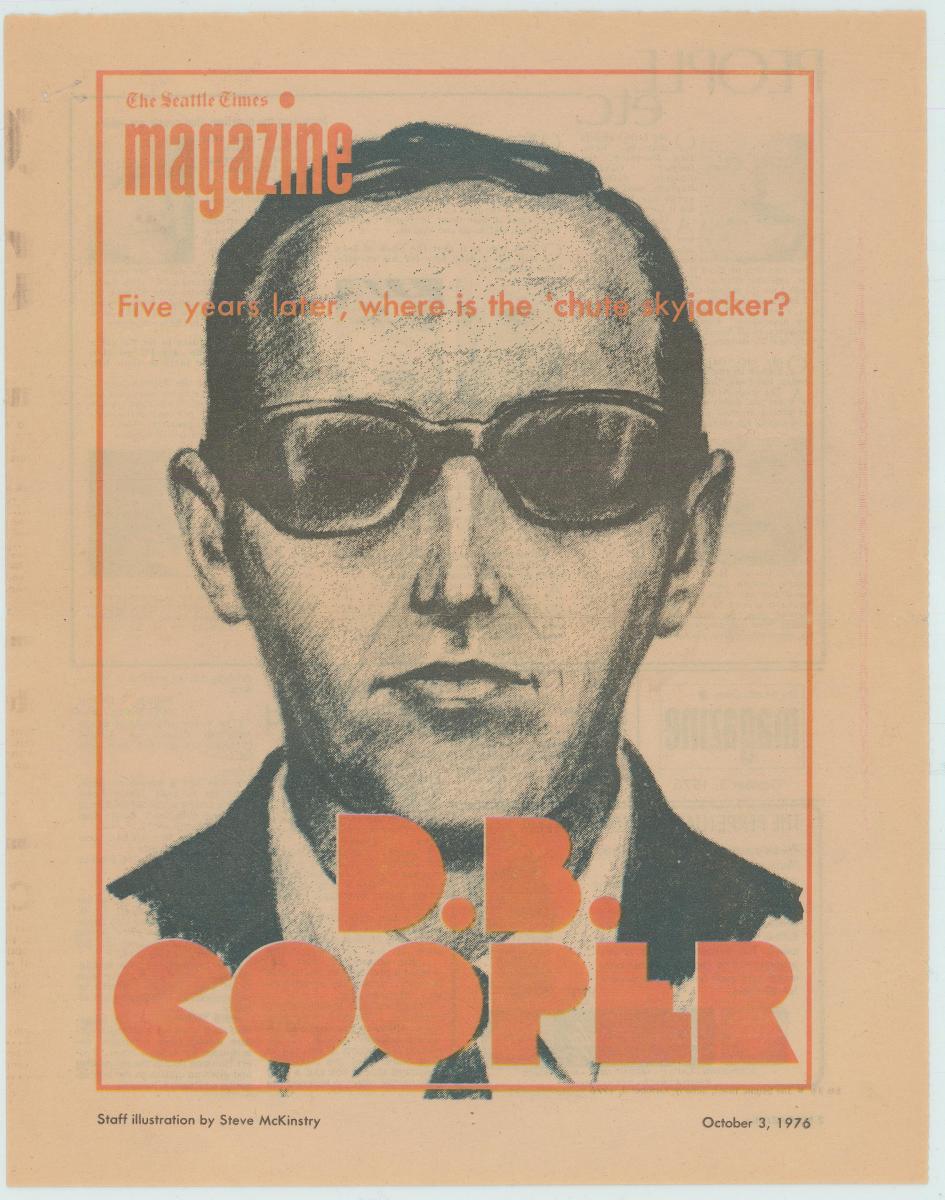
Under that line the file stops being a record and becomes an industry. Seven named men, four books in this file, a Netflix series, and a private team that announced the case solved and was not followed by any prosecuting authority.
What the assessment does not cover is the part that should trouble anyone who reads the whole file.
It does not explain how a case with this much paper produced this little evidence. One necktie, two parachutes, a bag, a cord, a placard and a stack of ruined banknotes, against one hundred and twenty one parts of vault documents and a case file at the National Archives that has never been fully digitized.
It does not explain Tina Bar. Money that should have been on a man, or in the trees, or gone, was in river sand nine years later, still in bundles.
And it does not explain the shape of the ending. The Bureau did not conclude this case. It reallocated it.
The Bureau’s public vault on this case runs to one hundred and twenty one parts. Two more releases arrived in 2025, nine years after the investigation officially stopped, and one of them contained a report written less than three months after the hijacking.
Every one of those pages is a record of men looking for a name. None of them found it.
Every document named on this page, and the ones that did not fit here, is filed and tagged in the Evidence Files dossier for this case.
What is held on record. What is only linked. And what is repeated everywhere without a source behind it.
„But who knows the fate of his bones, or how often he is to be buried?” — Sir Thomas Browne.
Unsolved Files. The truth was never meant to be found.

