
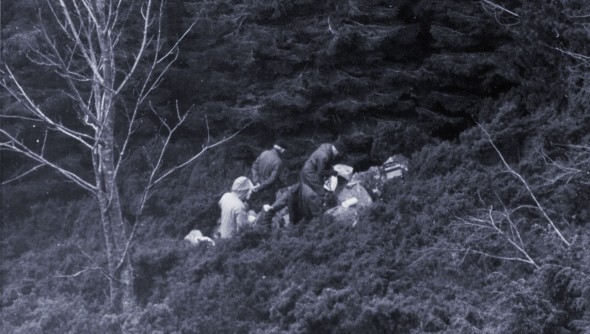
November 29, 1970. A reindeer herder hikes through Isdalen—the “Ice Valley”—a narrow gorge near Bergen, Norway. Snow clings to the black rock. Wind howls through the pines. And there, half-buried in a frozen streambed, lies a woman.
She is burned. Not charred—burned with precision. Her hands are gone. Her face is unrecognizable. But her clothes are intact. Her hair, neatly coiffed, untouched by flame. In her pockets: eight fake passports. All with her photo. All with different names.
And in her suitcase—one sheet of hotel notepaper, covered in a code that has defied cryptographers for over 50 years.
The Hotel Horda Trail
She checked into Bergen’s Hotel Horda on November 24, 1970, under the name “Elizabeth L. T.”—one of her forged identities. She paid in cash. Spoke fluent German, French, and English. Ordered dinner in her room: clear soup, boiled beef, black coffee. No alcohol.
On November 28, she checked out—leaving two suitcases behind, claiming she’d return that evening. She never did.
Hotel staff recalled her as “calm, precise, always dressed impeccably.” She made no phone calls. Received no visitors. But she did ask for a map of the surrounding fjords—and circled Isdalen in pencil.
Why Isdalen? The valley is remote, yes—but it’s also five kilometers from Bergen’s main port, a known transit point for Cold War intelligence. And just 20 km from Sørnes, where NATO maintained a signals intelligence outpost. To a spy, it was the perfect place to vanish: visible enough to be seen arriving, invisible enough to disappear forever.
The Code That Was Meant to Be Read—By Someone
Found in her room at Hotel Horda, the note wasn’t hidden. It was left in plain sight—scrawled in neat, deliberate handwriting across three pages of hotel stationery:
Page 1:
10 M
11 M 16 ML
17 M 19 MG
20 M 23 MO
24 M 31 M B
H
3AR
Page 2:
A23 A29F
A30 M14R
M15 M U V
M22 M31W
J4 J7N
J8 N R
Page 3:
J8 J21R
J22 P-73 JJ4PL
JJ4L JJ16 JJ16 LA
JJ16+7+
JJ18 R0 22 028 P 029 PS
029 S
030 B N5
N678 T N8T0S
N9 K18 S#
N18 B
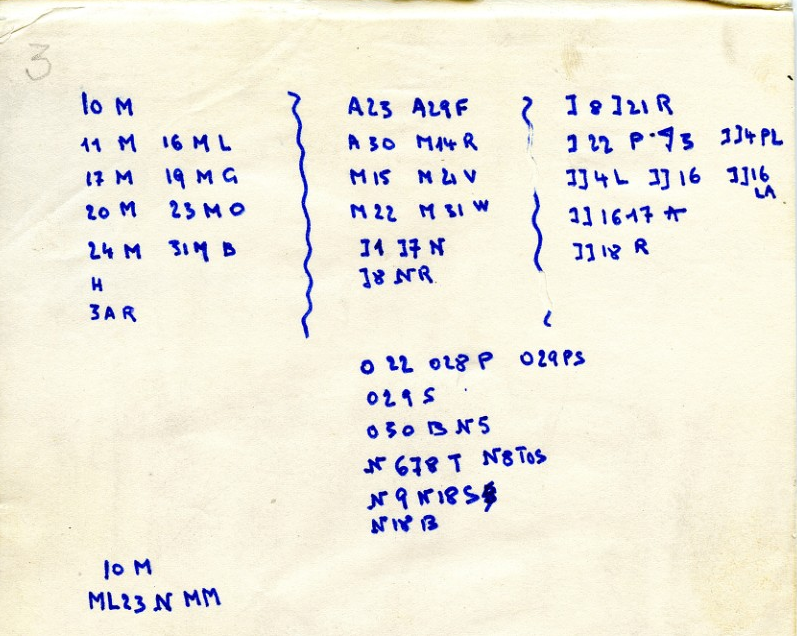
No explanation. No key. Just a system of numbers and letters that pulses with intention.
For decades, experts have tried to crack it:
- Dates? The sequence `10 M`, `11 M`, `16 ML` may refer to days in November—but why skip 12, 13, 14?
- Locations? `ML`, `MG`, `MO`, `MB` could be cities or hotels—but no match in 1970 Bergen records.
- Operational shorthand? The pairing of letters and numbers (`A23`, `J8`, `N9`) resembles Cold War field codes: `A` = agent, `J` = drop zone, `N` = contact.
- Package tracking? `P 028`, `PS`, `S#` suggest coded references to shipments or secure materials.
In 2019, Norway’s National Security Authority shared the code with NSA cryptanalysts. Their conclusion: “Consistent with Cold War courier protocols, but key unknown.”
The most unsettling possibility? This wasn’t a random note. It was a final operational log—written as she prepared to vanish. Not a message to the future… but a map for someone who was supposed to follow.
A Body Built for Disappearance
The autopsy revealed a woman in her late 30s, well-nourished, European, with dental work suggesting Central or Eastern Europe. She stood 168 cm tall. She wore expensive clothes: a beige coat from Paris, leather gloves, handmade shoes. In her suitcase—found days later at Bergen’s Hotel Horda—were labels removed, tags burned off, serial numbers scratched away.
But the true strangeness lay in the death itself.
She hadn’t died in the fire. Toxicology showed high levels of phenobarbital—a sedative—before the flames reached her. Someone had drugged her. Then doused her in petrol. Then set her alight.
Yet there were no signs of struggle. No defensive wounds. No footprints leading away. Just a body, placed deliberately in a remote valley, as if left as a message—or a warning.
The Suitcase of Ghosts
Beyond the code, the suitcase held more ghosts:
- Eight passports: Austrian, Belgian, German, French… all forged, all expertly made. All bore the same photo: a poised, dark-haired woman with calm eyes.
- No fingerprints: Every surface wiped clean.
- Burned labels: On clothes, toiletries, even the suitcase lining.
- Radioactive traces: On her clothes and suitcase. Not enough to harm—but enough to suggest contact with sensitive materials (e.g., nuclear smuggling).
This wasn’t improvisation. It was protocol. The work of someone trained to vanish—and to take secrets to the grave.
The Cold War’s Silent Pawn
1970. Europe is a chessboard. The Berlin Wall stands. The KGB and CIA wage shadow wars through diplomats, scientists, and couriers. Norway—neutral but NATO-aligned—is a listening post, a transit zone, a place where secrets change hands in hotel lobbies.
Norwegian police concluded: this was an execution disguised as an accident. But by whom?
Was she a Stasi operative running from East Germany? A Mossad informant selling secrets too dangerous to keep? A CIA asset who knew too much about nuclear smuggling routes through Scandinavia?
Files were shared with 25 countries. Interpol issued a global alert. Yet no government claimed her. No family came forward. It was as if she had never existed.
The Name That Never Stuck
In 2016, a team proposed she was Elizabeth Tronstad, a Norwegian woman who vanished in the 1950s. But dental records didn’t match. The theory collapsed.
More recently, declassified Stasi files mentioned a “female courier, code-named Nachtigall (Nightingale), missing in Norway, 1970.” But no photo. No file number. Just a whisper in a sea of redacted pages.
The Archive That Won’t Close
To this day, the Isdal Woman case remains partially classified by the Norwegian Police Security Service (PST). In 2020, journalists filed a freedom-of-information request to declassify all files. The response: “Release would harm national security interests.”
Her body, once buried in an unmarked grave in Bergen, was exhumed in 2019 for DNA testing. The results were never made public.
And the code? Still unsolved. Still waiting.
Why the Code Still Matters
The Isdal Woman endures not because of the fire—but because of the silence that followed.
And because of that code.
Someone, somewhere, knows what it means. They may be dead. They may be hiding. But as long as the code remains unbroken, her mission isn’t over.
In an age of digital traces—of facial recognition, of metadata, of omnipresent surveillance—her erasure is almost impossible to replicate. She is a ghost from the analog age, when a person could vanish not by going offline, but by never having existed at all.
And perhaps that was the point.
Evidence File
The original police photos. Scans of the coded note (as found in Hotel Horda). Passport forgeries. Autopsy report. Radioactivity logs. Declassified intelligence fragments.
Compiled from the Bergen Police Archives and verified European sources.
📥 Download: The Isdal Woman – Official Case File (PDF)
She left a message.
We just haven’t learned how to read it yet.

